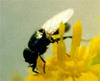
Classification: Milichiella lacteipennis
Larvae are saprophagous, coprophagous and necrophagous. Females are
kleptoparasitic on spiders and predaceous insects. In a rearing
experiment with compost from Gomera the development from egg to adult
lasted 4-7 weeks (in Germany) with the the puparium lasting about 2
weeks.
almost cosmopolitan in warm (mediterranean to tropical) areas
Classification: Milichiella lacteipennis
Differs from congeners in the combination of posterior eye margin with notch, shiny black mesonotum, yellow halter and male abdomen with T2-4 slightly brown microtomentose except for shiny black posterolateral edges
subshiny black, ocellar triangle and upper orbital plates shiny black
shiny black, scutellum brown microtomentose, pleura with anepisternum and middle of katepisternum shiny, otherwise slightly brown microtomentose
0.3x as long as epandrium high, dilated posteroapically (1.2x), slightly bent anteriorly, straight in posterior view, 1.3x as long as wide
shiny black, scutellum brown microtomentose, pleura anterodorsally shiny, posteroventrally slightly greyish microtomentose, except for shiny spot on katepisternum
There are one male and two female syntypes of Milichiella lacteipennis in MCZ. The male which has been photographed (Type 13451, Anonymous 2009) was designated as lectotype by Brake (2009).
There is one female ST of M. nitida in BMNH. Walker did not state the number or sex of the type specimens of M. nitida. The female specimen in BMNH was designated as the lectotype by Brake (2009) to permit synonymy of M. nitida with M. lacteipennis. Gymnopa nitida Walker, 1836 is thus the senior synonym of M. lacteipennis. However, the name Gymnopa nitida has not been used in original literature after 1899 (only in catalogues), whereas the name Milichiella lacteipennis has been in frequent use. M. lacteipennis is therefore designated as the valid name following ICZN Art. 23.9. Photographs of the male ST of M. lacteipennis are shown in the MCZ type database.
Specimens studied by Brake (2009) were collected on goat, dairy cattle and pig dung, manure piles, grass clippings, garden compost, flowers of Donnellsmithia hintonii M&G., Asclepias, Baccharis glutinosa, Ochradenus baccatus, Tamarix, and leaves of pawpaw, and in Malaise, light, flight, pan, pit fall, carrion, and dung traps. Habitats are arid zones, beach forest, forest edges, mountain meadows and ponderosa pine/meadow. Flies were bred from decaying banana skins and ground-nut plots. Milichiella lacteipennis was observed swarming beside cactus and was attracted by raw or linseed oil or paint.
America, from southern Canada south to Chile and Argentinia; southern Europe to Japan, south to Africa and Australia; Pacific islands; country map click here
Classification: Milichiella lacteipennis

Classification: Milichiella; Milichiella lacteipennis
Associated taxa: Brunneria borealis; Pentatomidae
Classification: Milichiella lacteipennis
Citation keywords: kleptoparasitic
Photo and video of milichiids, possibly Milichiella lacteipennis on prey of robber fly (Asilidae)
Classification: Milichiella lacteipennis; Milichiidae
Associated taxa: Asilidae
Citation keywords: kleptoparasitic
Markers denote occurence on country level. Blue markers denote verified specimens, red markers literature citations.
Classification: Milichiella lacteipennis
The Milichiidae fauna of Greece is virtually unknown, with only Desmometopa m-nigrum, Leptometopa rufifrons and Milichia pubescens (Brake 2000) recorded. However, thanks to the efforts of Gordon Ramel, who maintained several Malaise as well as other traps near Lake Kerkini in northern Greece, close to the border to Bulgaria, this has now changed. Sadly the first parcel with specimens sent to me was lost, so that the absence of data for some traps and times as well as the low numbers in some traps are not necessarily reflecting the original collection.
Classification: Desmometopa discipalpis; Desmometopa microps; Desmometopa sordida; Enigmilichia; Leptometopa latipes; Leptometopa niveipennis; Leptometopa rufifrons; Madiza; Madiza glabra; Milichia ludens; Milichia speciosa; Milichiella argyrogaster; Milichiella iberica; Milichiella lacteipennis; Neophyllomyza acyglossa; Paramyia hungarica; Phyllomyza flavitarsis Meigen; Phyllomyza longipalpis; Phyllomyza securicornis; Phyllomyza sp. Sultanitsa
Lobioptera lacteipennis Loew, 1866: 185. CUBA. LT m# MCZ [pres. des.]. Osten Sacken 1878: 210 [catalogue, North America]; Johnson 1895: 339 [Florida], 1904b: 163 [New Jersey]; Anonymous 2009 [type information, photos].
Classification: Milichiella lacteipennis; Milichiella nigrella; Milichiella nitida